A-Z
An Alphabet
William Nicholson, artist
British, 1872–1949
New York, R. H. Russell, 1898
Lithograph on paper
ND497 .N533al
An Alphabet was issued in both a limited edition with hand-colored woodcut prints for collectors, as well as in a larger edition featuring lithographic reproductions intended mainly for children (seen here). The Clark’s copy is well used and includes extensive annotations in pencil by a former young owner, a Miss Eleanor Hawkes, who helpfully signed her name on the inside cover.

ABC
Jules Lemaître, author
French, 1853-1914
Tours, Imprimerie Mame, c.1919
ND3345 .L45
This occasionally moralizing volume is lightened by fantastical anthropomorphized illustrations. Under the letter E, Escargot presents the story of a childless snail couple who adopt a passing orphan. Their story continues on the following page, Fourmi, when their ant neighbors are tasked with finding the young snail a fiancé to encourage much sought after grandchildren.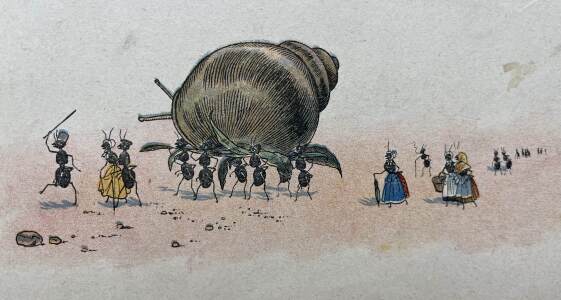
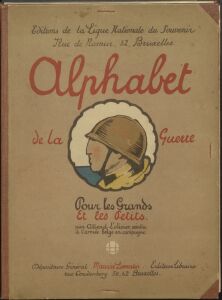
Alphabet de la Guerre: Pour les Grands et les Petits
Fernand Allard l'Olivier, artist
Belgian,  1883–1933
Brussels, Dépositaire général Maurice Lamertin, 1921
Color lithograph on paper
ND673 .A423.8a
As the title indicates, this book was intended for both children and adults and was published in a popular trade edition and in this deluxe limited version. The subject matter memorialized but did not idealize the First World War. As an official war artist with the Belgian Army, l’Olivier had firsthand knowledge of his subject.
Damn Everything but the Circus: a Lot of Things Put Together
Corita Kent
American, 1918–1986
New York, Holt, Rinehart and Winston, 1970
ND553 .D541.8a
The uplifting messages of this Pop Art alphabet book exemplify the spirit of Sister Corita Kent’s art. She combines the electric colors of the late 1960s with antique typography, Victorian images, and quotations from a variety of sources. To illustrate the letter E, she playfully transposes an eye for the letter I in Camus’s quote, “I should like to be able to love my country and still love justice.”
Alfabeto
Sonia Delaunay
French,  1885–1979
Venice, Emme, c. 1970
ND553 .D541.8a
By 1970, Sonia Delaunay was a recognized star of the art world. This late-career children’s book shows the continuation of her delight in the interplay between color, geometric shapes, and words.
This book was published in several countries, with each language using a different set of texts. In this Italian edition, the letter N becomes a lullaby based on the soporific nanna, a diminutive for sleep.
Translation for N:
Sleep, sleep, sleep, oh!
Who do I give the baby to?
If I give him to the Befana
She will keep him for a week;
If I give him to the black ox,
He will keep him for a whole year.
Sleep, sleep, go to bed,
The baby sleeps!
An Encyclopedia of Gardening for Colored Children
Jamaica Kincaid, author
Antiguan-American, b. 1949

Kara Walker, illustrator
American,  b. 1969
New York, Farrar, Straus and Giroux, 2024
NF237 .W243.5e
Kara Walker moves outside of her familiar style of stark silhouettes to illustrate this cultural history of Colonialism in the guise of a children’s alphabet book. While her watercolor images have a dreamy character, they poignantly illustrate Jamaica Kincaid’s rich botanical histories.
Heures a lusage de Rome
Artist unknown
French, active second half of the 15th century
Paris, pour Simon Vostre, between 1488-1498
Woodcut, tempera, and gold on vellum
Robert Sterling Clark Collection of Rare Books
NE1255 .H49 1488
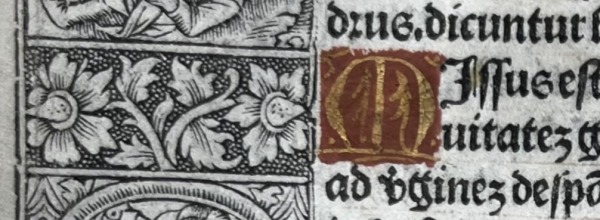
Printed in the incunabula period (between Gutenberg’s invention of the printing press in 1450 and the year 1500) Heures a lusage de Rome is the oldest book in the Clark’s collection. This Book of Hours (a book with prayers for specific times of day) was designed to imitate the Medieval illuminated manuscript versions produced by monks. It is printed on vellum, prepared animal skin, pages with modular woodcut borders which were rearranged and reused through the text to resemble intricately painted marginalia. Finally, the larger initial letters for each chapter were added by hand in gold on a blue or red square.
Künstlicher Bericht vnd allerzierlichste Beschreybung ... wie die Streitbarn Pferdt (durch welche ritterliche Tugendten mehrers Thails geübet)zum Ernst vnd ritterlicher Kurtzweil geschickt vnd volkommen zumachen.
Federico Grisone, author
Italian, 1507–1570

Jost Ammann, artist
1531–1593
Augsburg, G. Willers, 1570
Robert Sterling Clark Collection of Rare Books
ND588 .A5.5b
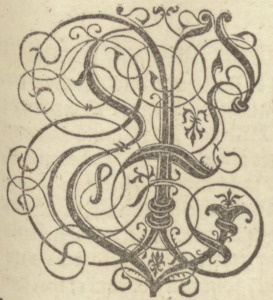
This is the first German language edition of Federico Grisone’s early and important book on horsemanship. The ornate equipment depicted is equaled by the exuberant decoration of the initial letters. Here an elaborate letter E in Fraktur, or Germanic, typeface begins chapter five, “Es ist fundt unnd bewust (It is known and understood)...”
The birth, life, and acts of King Arthur of his noble knights of the Round table their marvellous enquests and adventures the achieving of the San Greal and in the end le morte Darthur with the dolourous death and departing out of this world of them all
Sir Thomas Malory, author
British, active 15th century

Aubrey Beardsley, illustrator
British, 1872–1898
London, J. M. Dent & Company, 1893–94
Given in memory of John Haldeman Winant with loving reflection from his family
ND497 .B38.3m v. 2
This was Aubrey Beardsley’s first commissioned work. At the age of 21, he had already developed the starkly elegant black-and-white drawing style that would become synonymous with his name. Beardsley nodded to the Medieval period of the Arthurian tales in the illuminated initials. However, he modernized it in the contemporary Art Nouveau style, notably in the elegant, whiplash curves of the vines framing the page.

A Connecticut Yankee in King Arthur’s Court
Mark Twain, pseudonym for Samuel L. Clemens, author
American,  1835–1910

Daniel Carter Beard, illustrator
American,  1850–1941
New York: C.L. Webster & Company, 1889
Robert Sterling Clark Collection of Rare Books
ND237 .B286.5c
Daniel Beard had a great interest in social and economic change. This meshed nicely with Twain’s novel, which involves a modern man transported back to the court of King Arthur, where he surreptitiously introduces all matter of reforms. With the author’s blessing, Beard’s illustrations highlight the societal aspects of the story as almost political cartoons.
Beard evokes the medieval setting of Twain’s tale with an historiated initial at the start of each chapter. Here, a knight errant advertises soap by means of his elaborately decorated "fashionable sandwich board. This was one of the Yankee’s ploys to subvert the court by encouraging literacy and hygiene through the guise of courtly fashion.
Abeceda
Vítězslav Nezval, author
Czech, 1900–1958

Karel Teige, book designer
Czech, 1900-–951

Karel Paspa, photographer
Czech, 1899–1979

Milča Mayerová, choreographer and dancer
Czech, 1901–1977
Prague, J. Otto, 1926
NF533 .N575.8a
This avant-garde alphabet book began as a performance piece, with Mayerová dancing as Nezval‘s poems were recited. The event was later recreated and photographed for this volume. The collaborative nature of this project -- all participants were members of the Czech artists group, Devětsil Artistic Union -- along with the strikingly contemporary typography and design, make this slender book an icon of European modernism.
Translation for E:
From: V. Nezval, J. Toman and M. Witkovsky, translators, Alphabets. Ann Arbor, Michigan Slavic Publications, 2001
For you I can think of no comparison
Three lines your trilling tone rings through
But someone leads the operator on?
Three lines each equally true
The Silence is Golden Book
Karen Savage
American, b. 1948
[Chicago, Illinois], K. Savage, 1993
NF237 .S264.8s
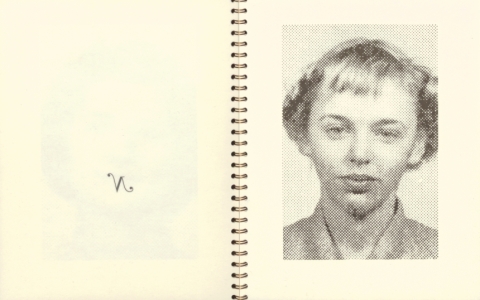
The text “Silence is golden and it screams louder…” is printed one letter per page on translucent sheets superimposed over the image of a woman’s face. The women’s hairstyles and clothing place the images from the mid-twentieth century, and the letters have been carefully positioned over their closed lips.
Libro de marchi de cavalli: con li nomi de tvtti li principi, & priuati signori che hanno razza di caualli (Book of horse brands: with the names of all the princes & private gentry who breed horses )
Venice, Bernardo Giunti, 1588
Robert Sterling Clark Collection of Rare Books
N7717 .L5 1588
This small book reproduces the ownership marks used by “the princes and private gentry” who bred horses in sixteenth-century Italy. Not surprisingly, many of the identifying brands incorporated the owner’s initials. The cover includes a stylized monogram of the book's former owner, Paul Couturier de Royas.

Alphabets
Possibly Berlin, 1860s
Pencil, transfer powder on paper
Mary Ann Beinecke Decorative Art Collection
ND3334 .A4
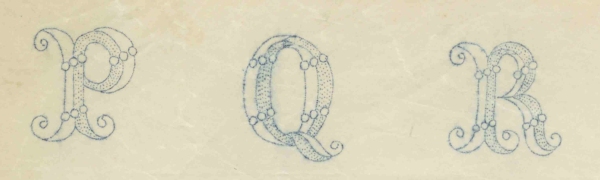
This oversized volume compiles the alphabet in assorted sizes and styles. Looking closely, the intricate letters are made up of close, fine dots, indicating that they were transferred to these sheets by hand. The prick and pounce transfer method uses a pin to pierce the outline of a shape, here the decorative letters. A fine, colored powder or chalk is then patted or ”pounced” over the page, dropping through the holes leaving a trace image of the original on the sheet below.
A Specimen book of type faces & decorative material in use at the Publishers Printing Company
Publishers Printing Company
New York : William Bradford Press, c. 1936
N7717 .L5 1588
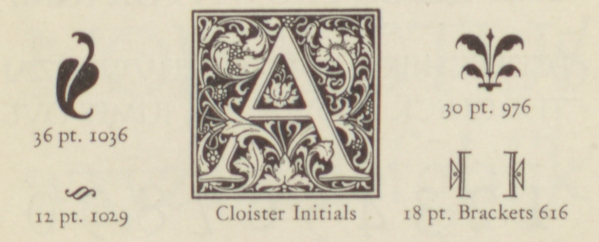
In addition to more than one hundred different typefaces this specimen book provides a variety of harmonious decorative borders, ornaments, and symbols that, according to the forward, “[when] properly arranged can carry your thoughts to the furthermost corners of the world.”
New patterns for embroidering, no. 7
Date and place of publication unknown
Chromolithograph on paper
Mary Ann Beinecke Decorative Art Collection
NK9205 .N48
New printing techniques available in the late nineteenth century allowed for the wide distribution of inexpensive patterns and manuals aimed at the home needleworker. This small booklet features different forms of the alphabet marked out on a grid and ready for use. With universal Latin characters, this could be widely marketed. The title is repeated on the cover in French, German, English, and Russian.

From a collection of Lao and English alphabet practice books [Learn to read and write Lao] [Learn to write – learn to read]
Laos, publisher unknown, c. 2000–2006
Gift of Sally Stein in memory of her husband, Allan Sekula
NE2698 .S4637L 14882
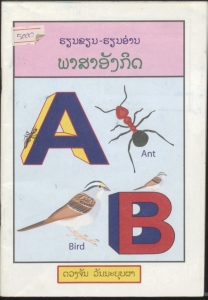
The traditional use of alphabet books as reading primers continues here as an aid to instruct children in Latin and Lao script. These volumes, part of Allan Sekula’s personal library, were likely acquired by the filmmaker, photographer, and professor while he was in Laos filming his Short Film for Laos (2006).
Illustrated sample book & price list of Palm's patent transfer letters: ornaments & trade designs for signs, wagons, cars, machines, etc.
Palm Letter Co.
International company, active in United States, 20th century–present
Cincinnati, Palm Letter Co., 1901
Mary Ann Beinecke Decorative Art Collection
NK1530 .P342
Palm Letter Co. was an international firm, active in the late nineteenth and into the twentieth centuries. The U.S. division was based in Cincinnati, Ohio. This catalog presents a range of decorative motifs and letters of various sizes and fonts that are available for purchase, primarily for commercial applications. Many of the letters feature a cast shadow for a three-dimensional effect. The letters were sold individually or in sheets of complete alphabets, with extra copies of the more widely used letters.
The ready-to-use letters were boldly colored and highly visible, perfect for the signs, wagons, and other uses noted in the title and suitable for wood, metal, glass, and other surfaces. They were easy to apply, involving the layer of mastic, a firm rubbing to move the image from the sheet to the object, and finally a gentle soak with water to remove the paper substrate.
Die Scheuche: Märchen
Kurt Schwitters
German,  1887–1948

Kate Traumann Steinitz
American ( born Germany), 1889–1975

Theo Van Doesburg
Dutch, 1883–1931
Hannover, Apossverlag, 1925
Gift of George Heard Hamilton
ND588 .S29.8s
Perhaps surprising for an anarchistic group that formed in response to the horror of the First World War, influential Dada artists Kurt Schwitters, Kate Steinitz, and Theo Van Doesburg collaborated on a group of children’s books in the 1920s. The Dada movement frequently included letters in their works, experimenting with a range of sizes, fonts/type, and positions on the page. In Die Scheuche, the scarecrow, farmer, and harassing birds are depicted as animated letters. Their expressive angles and placement convey a sense of frenzied movement.
Though initially included in the checklist this volume was not on display due to conservation concerns.