Bold by Design
The Ghost in the Underblows
Alfred Young Fisher, author
American, 1902–1970

Alvin Lustig, book designer
American, 1915–1955
Los Angeles, Ward Ritchie Press, 1940
Purchased with funds provided by Daniel P. Davison Jr.
NE925 .L878f
A pioneer of modern American graphic design, Alvin Lustig was known for his book cover designs, often characterized by simple shapes and flat colors. Here, for Alfred Young Fisher’s The Ghost in the Underblows, he created dynamic abstract illustrations out of type ornaments—the small shapes that printers would typically use to fill gaps or add borders in traditional letterpress typesetting.
Looking Backward: 2000–1887
Edward Bellamy, author
American, 1850–1898
Merle Armitage, book designer
American, 1893–1975
Elise Cavanna, illustrator
American, 1902–1963
New York:, Limited Editions Club, 1941
N8217 .U86 B455
Merle Armitage was, among many other occupations, an innovative and well-known book designer. Looking Backward by Edward Bellamy tells the story of a young man who falls asleep in 1887 and wakes up in the year 2000. In turn, Armitage’s design for this special edition envisions how a book printed in the year 2000 might appear. His gestures to the future lie not only in the graphic design but materials used. The bright yellow cover is printed on DuPont-engineered fabric and the book was originally enclosed in a clear plastic slipcase, "giving the appearance of having been frozen in a cake of ice," as Armitage observed. "I believe this book in some respects does approach the book of tomorrow."
1Merle Armitage, Notes on Modern Printing (Wm. E. Rudge’s Sons, 1945) 64.
Modern Man in the Making
Otto Neurath, author and illustrator
Austrian, 1882–1945
New York:, Alfred A. Knopf, 1939
Gift of Sally Stein in memory of her husband, Allan Sekula
NE2698 .S4637L 11839
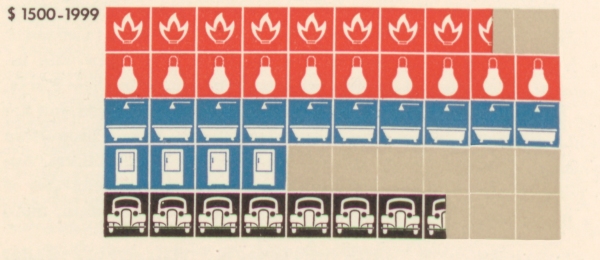
Trained as a sociologist and political economist, Otto Neurath is perhaps best known as the creator of the isotype (International System of Typographic Picture Education). This new graphic art form became a universal method for disseminating information. Moving beyond the confines of language, isotypes repeat standardized pictograms to show differing quantities of any given category. Modern Man in the Making presented the state of the world in the 1930s through text, graphs, and isotype charts.
Partiturskizze zu einer Mechanischen Exzentrik (Sketch for a Score for a Mechanized Eccentric)
Bauhausbücher, no. 4
László Moholy-Nagy, artist
Hungarian, 1895–1946
Munich: Albert Langen Verlag, 1925
Gift of George Heard Hamilton
N6868.5 .B28 B2
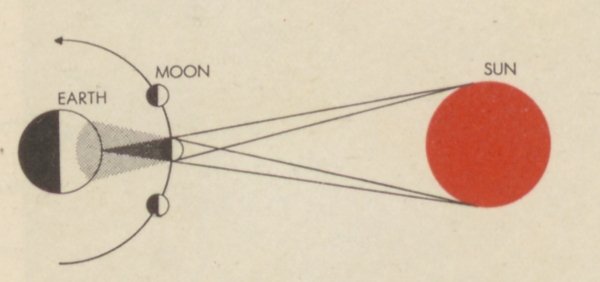
Best known as a painter and photographer, László Moholy-Nagy worked across a wide range of artistic disciplines. This schematic, included in the fourth issue of Bauhausbücher, a volume dedicated to Bauhaus ideas on theater, captures Moholy-Nagy’s visual representation of his “Theater of Totality,” an immersive theatrical performance. He splits the elements of form, motion, light, and sound into columns. When taken together horizontally across the page, these elements combine to communicate the direction and score for a performance.

World Geo-Graphic Atlas, a Composite of Man's Environment
Herbert Bayer, book designer
American (born in Austria), 1900–1985
Chicago: privately printed for Container Corporation of America, 1953
ND237 .B278.8w
Herbert Bayer studied and then taught at the Bauhaus before eventually emigrating to the United States in 1937, finding work as a design consultant for the Container Corporation of America. The World Geo-Graphic Atlas, despite being produced solely as a gift for CCA customers and never offered for sale, was massively popular and remains an important landmark in the fusion of information and graphic design. In this early masterpiece of the infographic, Bayer uses color theory, isotypes (see Modern Man in the Making), and Bauhaus design principles that prioritize functionality and clarity of expression, allowing the reader to easily grasp the wealth of complex information provided on each two-page spread.
Kenneth Noland
New York: Jewish Museum, 1965
ND237 .N57 J48 1965
Primary Structures: Younger American and British Sculptors
New York: Jewish Museum, 1966
NB212 .N488 1966
Elaine Lustig Cohen, book designer
American, 1927–2016
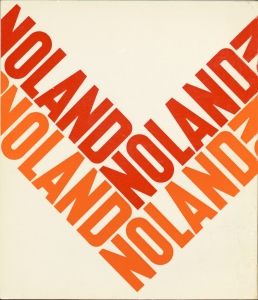
Elaine Lustig Cohen was an artist and designer whose work in the 1960s embraced hard-edged abstraction and a visual vocabulary of modernist design. From 1962 to 1967, she worked with the Jewish Museum to establish its institutional identity, designing catalogs, posters, and other ephemera for its pioneering exhibition program. Trained as a fine artist, Lustig Cohen transitioned to graphic art when she took over her first husband Alvin Lustig’s design firm following his early death in 1955.
The Printing Art Quarterly, Winter 1936
Carl J. H. Anderson, designer
American, active 1930s
Chicago: Dartnell Publications, Inc., 1936
Gift of Sally Stein in memory of her husband, Allan Sekula
NE2698 .S4637L 03869 v.66, no.1 (1936)
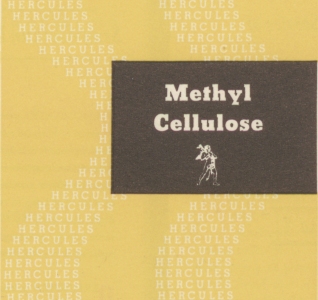
This array of booklet covers is part of an article aimed at professionals in the printing and marketing industry that showcases the work of typographer and designer Carl J. H. Anderson. These striking designs incorporate each client’s company name and logo, bringing life to the branding of otherwise mundane products, such as methyl cellulose (wallpaper paste) and Vinsol resin (asphalt emulsion extracted from pine stumps).
Worlds Fairs: New York, San Francisco.
The Architectural Forum, vol. 70, no. 6
Will Burtin, artist
American (born in Germany), 1908–1972
New York:, Time, Inc., 1939
Gift of Sally Stein in memory of her husband, Allan Sekula
NE2698 .S4637L 04063
The 1939 New York World’s Fair and its West Coast counterpart, San Francisco’s Golden Gate International Exhibition, gave millions of visitors a glimpse of “the world of tomorrow.” Will Burtin, a German designer who emigrated to the United States in 1938, designed the official symbols of both fairs, featured on this volume of The Architectural Forum. Burtin combined the minimalist, geometric, Bauhaus-inspired aesthetic popular in Europe at the time with his personal interest in science- and technology-inspired imagery, propelling the visual identity of both fairs into the future.
Printing Year Book & Almanac 1940–41
Charles C. Walden, Jr., editor
American, 1886–1962
New York: Walden, Sons & Mott, Inc., 1940
David A. Hanson Collection of the History of Photomechanical Reproduction
NE2610 .P75
One goal of advertising is to make a big impact with a small price tag. As each color requires a separate pass through the printing press, a surefire and cost-effective way to catch the reader’s eye is to use strong black and white text with just one bold color choice. The yellow background of this ad for Dill & Collins commercial printing paper is hard to miss.
Advertising and Publishing Production Yearbook, vol. 8
Bradbury Thompson, art director
American, 1911–1995
New York: Colton Press, 1948
David A. Hanson Collection of the History of Photomechanical Reproduction
N1 .A18
This annual publication was produced for professional printers and showcased new techniques and trends in the industry. The cover design of this particular issue features the four basic colors used in commercial offset printing—cyan, magenta, yellow, and black (CMYK)—presented in a common dot pattern known as halftone. These dots are normally printed so small they can only be seen with a magnifying glass, but when viewed with the naked eye, they create the illusion of continuous tone.
Pour la Peinture
Léon-Paul Fargue, author
French, 1876–1947

Mario Prassinos, book designer
French, 1916–1985
Paris: Gallimard, 1955
ND547 .F275
Mario Prassinos famously designed over two hundred book covers during the 1940s and 1950s for Gallimard’s series La Nouvelle Revue Française (NRF). Many of these covers are notable for their geometric abstract patterns using a limited color palette.
II. Documenta '59: Kunst nach 1945
Arnold Bode, design and typography
German, 1900–1977
Cologne: M. DuMont Schauberg, 1959
N5198 .K38 1959 v.1–3
Noted architect, painter, designer, and curator Arnold Bode founded the recurring art exhibition, Documenta, in 1955 in Kassel, Germany. As organizer of the first four installations of Documenta, he developed a strong graphic identity for the exhibition and catalogue designs. Documenta is still held every five years, with Documenta 16 scheduled for 2027.
Aspen: The Magazine in a Box, vol.1, no.4
Marshall McLuhan, author
Canadian, 1911–1980

Quentin Fiore, designer
American, 1920–2019
New York: Roaring Fork Press Inc., Spring 1967
N1 .A8646 no.4
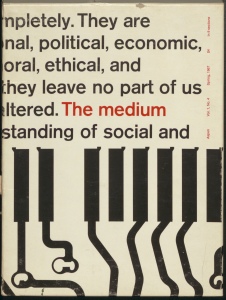
Aspen, envisioned as the first three-dimensional magazine, published a total of ten issues between 1965 and 1971. Each issue centered around a theme and included a variety of materials—such as posters, flip books, and audio flexidisks—contributed by contemporary artists. Issue number 4 explores Canadian philosopher Marshall McLuhan’s theories on media as presented in his and collaborator Quentin Fiore’s best-selling book, The Medium is the Massage, which had been released just prior to this issue’s publication. The magazine reproduces images and quotes from the book; other notable elements include John Cage’s essay Diary: How to Improve the World (You Will Only Make Matters Worse) and a sampler of electronic music from Mario Davidovsky and Gordon Mumma.
Collectie Bo Boustedt, catalogus nr. 359
Wim Crouwel, book designer
Dutch, 1928–2019
Amsterdam: Stedelijk Museum, 1964
N2456 .A1.5 No. 359
Multi-disciplinary designer Wim Crouwel is best known for his work designing museum publications, first for the Van Abbemuseum in Eindhoven in the 1950s and then as design director at the Stedlijk Museum in Amsterdam from 1963 until 1985. His interest in the grid as a basis for design led to the nickname “Mr. Gridnik,” a name he also gave to the angular typeface he designed in 1974.
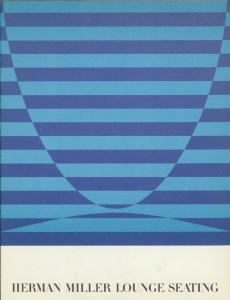
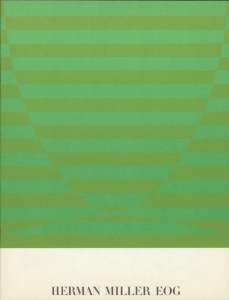
Herman Miller product brochures
George Nelson & Co., design firm
Tomoko Miho, designer
American, 1931–2012
Zeeland, Michigan: Herman Miller, 1961
NK2439 .M55e
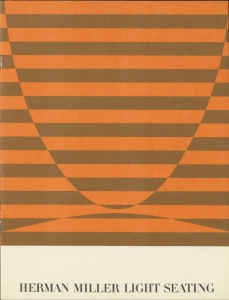
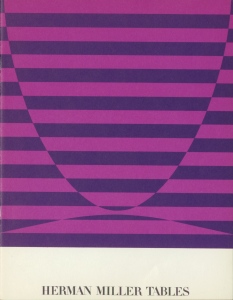
This suite of product brochures designed by Japanese American designer Tomoko Miho features a highly stylized representation of the company logo on the cover in vivid colors, with clear, minimalist photographs of each product inside. This visual approach—highlighting an isolated product against an empty background—would have a lasting impact on furniture catalogs across the industry for decades.
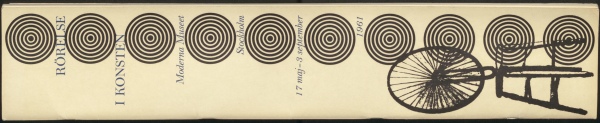
Rörelse i Konsten
K. G. Hultén, editor
Swedish, 1924–2006
Hubert Johansson, designer
Swedish, born 1918
Stockholm, Sweden: Moderna museet, 1961
N6493 .S86 1961
Intended to resemble a French baguette, this extremely tall exhibition catalog was designed to turn heads, providing publicity for a major exhibition featuring 233 works of kinetic art held at the Moderna Museet in Stockholm Sweden and two other venues in 1961. The cover features a silhouette of Marcel Duchamp’s readymade sculpture Bicycle Wheel superimposed over a tower of bullseye motifs that, through an optical effect, almost seem to spin as the text drops down the page.