
Gridlocked
For centuries, weavers have documented their work in weaving pattern books, utilizing a grid format to record both the design and the respective threading of the loom. Taken as isolated images, these grids can function as standalone units or they can create more complex patterns through limitless repetition.
Individual weavers were often protective of these patterns, as they represented proprietary information. Once someone knows how to decipher the diagrams, they too can recreate the design for themself. Whether hand-drawn for personal use or printed for mass distribution, these working manuals provide clear instruction to achieve a desired effect.
Weber Kunst Buch
Nathanael Lumscher, author
German, active 1708–1737
Culmbach, Nathanael Lumscher, 1709
Engraving on paper
Mary Ann Beinecke Decorative Art Collection
NK8805 .W43
Des Neu-erfundenen Weber Kunst- und Bild-Buchs
Nathanael Lumscher, author
German, active 1708–1737
Culmbach, Nathanael Lumscher, 1727
Woodcut on paper
Mary Ann Beinecke Decorative Art Collection
NK8805 .L85 3.Th. 1727
Neu-hervorkommendes Weber- Kunst- und Bild- Buch
Nathanael Lumscher, author
German, active 1708–1737
Culmbach, Nathanael Lumscher, 1736
Ink on paper
Mary Ann Beinecke Decorative Art Collection
NK8805 .L85 1736 v.1-4
This Book, Belonging to Henrich Woolhever, Bertytown, near York, Septem. 25th, 1821
Henrich Woolhever, author
American, active 1821
York County, Pennsylvania, 1821
Ink on paper
Mary Ann Beinecke Decorative Art Collection
NK8804 .W65
Mönster-Bok för Unga Fruntimmer: i, Konsten att tillverka vackra façonerade och dibble Väfnader
Maria Christina Trolle Ekenmark, author
German, Swedish, 1786–1850
Linköping, Axel Petre, 1826
Woodcut on paper
Mary Ann Beinecke Decorative Art Collection
NK8805 .E4
Manuscript weaving model book
Location unknown, 1759
Woodcut on paper
Mary Ann Beinecke Decorative Art Collection
NK8805 .F76
Things I learned: Kima 92
Lauren Kima Graycar, artist
American, active from 2013
Los Angeles, Kimabooks, 2020
Silkscreen on digital print
Mary Ann Beinecke Decorative Art Collection
NF237 .G7835.8t
Théorie de la fabrication des étoffes de soie, cours de J. Claude Cussinet, élève de Jules Meunier
Jean Claude Cussinet, artist
French, 1837-1841
France, 1841
Ink on paper
Mary Ann Beinecke Decorative Art Collection
NK8804 .C88
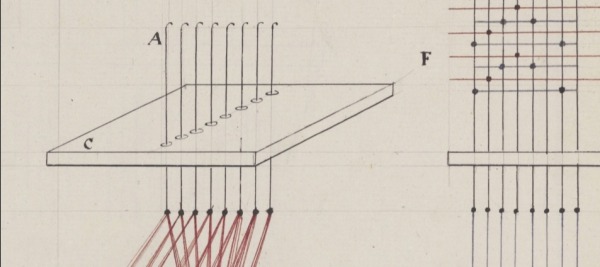
This highly detailed manuscript was created by Jean Claude Cussinet as evidence of his mastery of numerous methods of silk weaving production. It includes diagrams of loom threading, highly detailed patterns, and finished samples of cloth. His elaborate rendering of how to prepare a Jacquard loom is particularly striking.
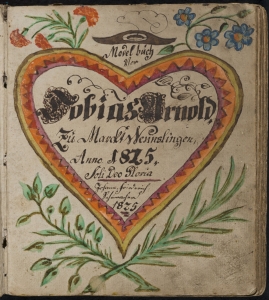
Modelbuch for Tobias Arnold
Tobias Arnold, artist
German, active 1825
Germany, 1825
Ink on paper
Mary Ann Beinecke Decorative Art Collection
NK8805 .M6
Tobias Arnold was likely a professional independent weaver. The roughhewn manuscript quality of the grid plotting belies the intricacy and variety of these coverlet patterns. This volume also boast a particularly decorative title page.
First Year Weaving: Manuscript notes, with samples of cloth
James Holmes, M.S.A., artist
British, active 1910
Burnley, 1900
Fabric samples, ink on paper
Mary Ann Beinecke Decorative Art Collection
NK8804 .H6 1900
Burnley was a major textile hub in England that produced both cloth and mechanical looms. By the late nineteenth century, the town was the largest manufacturer of cotton in the world. Production peaked with 99,000 looms active in Burnley in 1910, when James Holmes was studying for a career in textile manufacturing.
Skilled workers were essential for this flourishing industry. For this first-year weaving course, students practiced recording weaving patterns by finishing pre-printed designs in their notebooks. This helped them visualize a complete piece of fabric through an initial gridwork design.
Weber Buch von Herbert Walker
Herbert Walker, artist
Scottish, active 1903
Dunfermline, 1903
Cotton fabric samples, ink on paper
Mary Ann Beinecke Decorative Art Collection
NK8805 .W34 v.2
Both Dunfermline, Scotland and Sorau, Germany (now Zary, Poland) were textile manufacturing centers referenced by Herbert Walker on the front page of this volume. Dunfermline, Walker’s home, was renowned for its linen. This manuscript volume shows the international scope of the textile industry in the early twentieth century. It is likely that Walker traveled to Sorau to learn their weaving patterns and techniques, which he then documented in two volumes.
Design Book: Cloth-structure, 2nd Year, Weaving & Designing
Theodore Vivian Staub
British, active 1912–1918
Bradford, England, City of Bradford Technical College, 1912–13
Ink on paper
Mary Ann Beinecke Decorative Art Collection
NK8805 .S8
Bradford Technical College provided training in skills needed to support the area’s textile industry. This workbook from the early twentieth century was kept by a student at the college to document the second-year course on weaving and design. The notes and patterns described become increasingly complex—and visually interesting—reflecting the progression of the course.
Silk brocade sample book
Paris, 1886
Silk fabric samples
Mary Ann Beinecke Decorative Art Collection
NK8849 .M3
This sample book by an unknown French textile firm contains silk clippings with a vast range of patterns embedded in the brocade weave, featuring cows, dogs, horseshoes, cricket bats, fruit, flowers, and geometric shapes. The examples are also notable for their color, which has remained bright even after 140 years.
Eighteenth century textile samples from Asia
Location and date unknown
Silk fabric samples
Mary Ann Beinecke Decorative Art Collection
NK8872 .O75
This album features samples of patterned brocades, likely from East Asia. The intricacy of the weaving and the luxurious materials—including gold and silver threads—highlight the high caliber of textile creation in China and Japan during the eighteenth century.
A scrapbook of Scottish clan tartans
Sidney Herbert Elphinstone, 16th Lord Elphinstone
Scottish, 1869-1955
Location and date unknown
Fabric sample, ink on paper
Mary Ann Beinecke Decorative Art Collection
NK8845 .E4
Sidney Herbert Elphinstone, the 16th Lord Elphinstone, was an active figure in Scottish social and political groups. He was a Knight of the Thistle, one of the most ancient chivalric orders in Great Britain and tied exclusively to Scotland.
This unique album created for Elphinstone is a celebration of Scottish heritage. The collection pairs each sample of traditional tartan plaid with a drawing of a clan’s associated flower.
Negative Entropy: New York University Central Data Center
Mika Tajima, artist
American, b.1975
Paris, Three Star Books, 2015
NF237 .T1355.8n v.5
Mika Tajima visually explores the concept of the Jacquard weaving process as a precursor to computers and digital technology in this volume. The other four volumes in the set feature photographs of various weaving and fiber production facilities. This final volume focuses on New York University’s Central ITS Data Center, which creates its own kind of interwoven fabric of information. Data derived from images of the site was translated into Jacquard punch cards, which were then bound together with spectrogram images based on audio recordings of the Data Center’s machinery in action.