
Gridlocked: the Geometry of Weaving
November 2025-May 2026
The vast majority of textiles—from plain sackcloth to elaborate decorative drapery—are produced by weaving. In this ancient technique, long vertical threads (known as warp) are stretched across a loom and then interlaced in horizontal rows (known as weft) to form a grid pattern. This rigid structure has served as a solid foundation for countless combinations of colors, materials, and compositions where complex repetitive geometries form the very fabric itself.
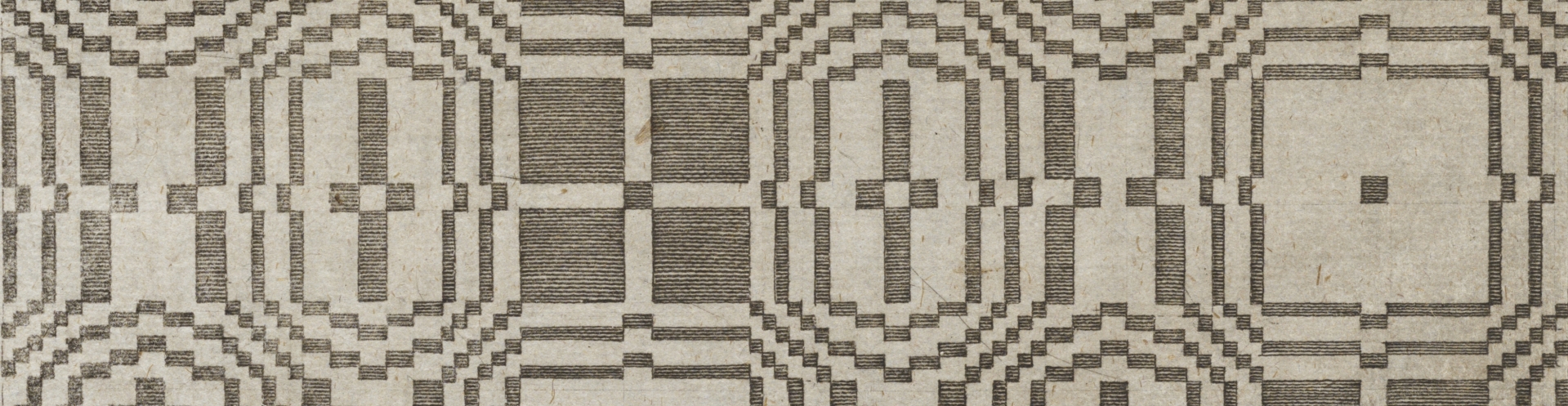
For centuries, weavers have documented their patterns in manuscript volumes, charting the thread arrangements on graph paper. These annotated grids can appear to contemporary eyes as abstract works of art, but when read in sequence, like a musical score, they form precise instructions to achieve the desired results. Initially produced on a small scale in the home, weaving slowly grew into a commercial enterprise. The apprentice model gave way to industrial schools as mechanization enabled the production of increasingly intricate fabrics on a large scale. Technological advances throughout the nineteenth century, such as the groundbreaking Jacquard card-and-loom system, revolutionized what cloth could look like.
The books gathered here showcase a range of fabrics, designs, and technologies originating across cultures and centuries. Geometric shapes and patterns are the common threads that run between them
Gridlocked: the Geometry of Weaving
November 2025-May 2026
The vast majority of textiles—from plain sackcloth to elaborate decorative drapery—are produced by weaving. In this ancient technique, long vertical threads (known as warp) are stretched across a loom and then interlaced in horizontal rows (known as weft) to form a grid pattern. This rigid structure has served as a solid foundation for countless combinations of colors, materials, and compositions where complex repetitive geometries form the very fabric itself.
For centuries, weavers have documented their patterns in manuscript volumes, charting the thread arrangements on graph paper. These annotated grids can appear to contemporary eyes as abstract works of art, but when read in sequence, like a musical score, they form precise instructions to achieve the desired results. Initially produced on a small scale in the home, weaving slowly grew into a commercial enterprise. The apprentice model gave way to industrial schools as mechanization enabled the production of increasingly intricate fabrics on a large scale. Technological advances throughout the nineteenth century, such as the groundbreaking Jacquard card-and-loom system, revolutionized what cloth could look like.
The books gathered here showcase a range of fabrics, designs, and technologies originating across cultures and centuries. Geometric shapes and patterns are the common threads that run between them